Chief One Papa: The Lakota Leader Immortalized on the 1899 $5 Bill
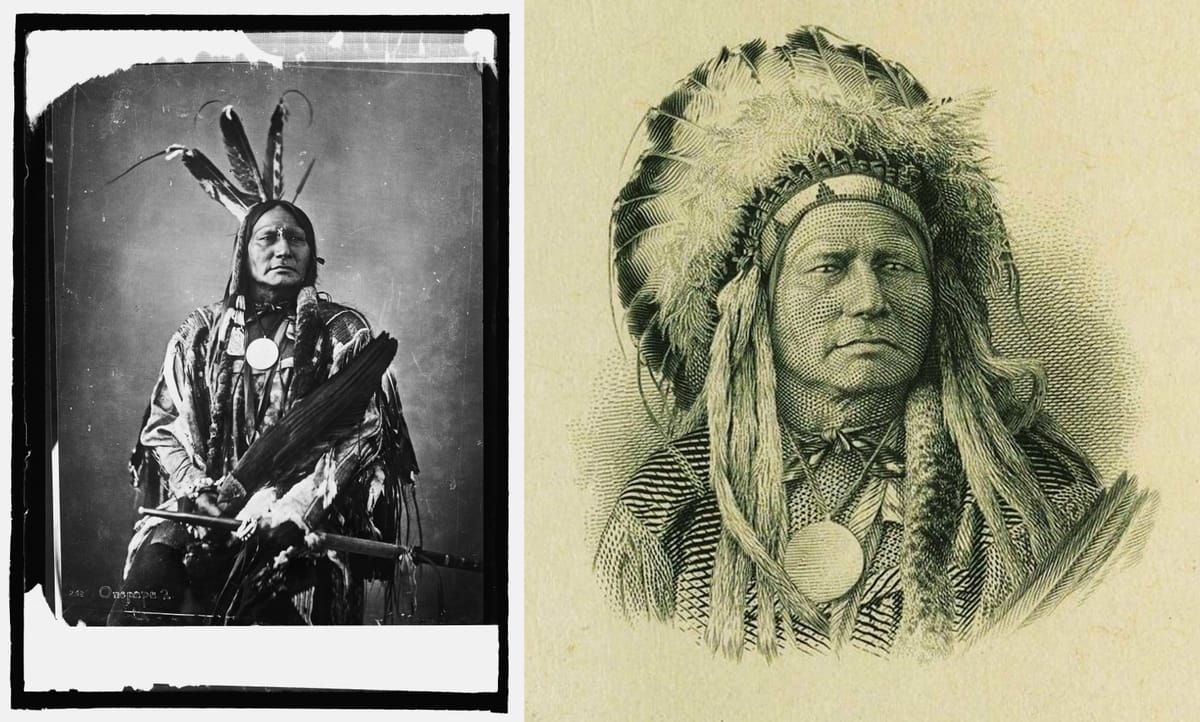
In the world of American currency, few notes capture the imagination quite like the Series of 1899 $5 Silver Certificate—affectionately (and sometimes commercially) nicknamed the "Indian Chief Note," "One Papa," "Oncpapa," or "Chief One Papa." This large, beautifully engraved bill stands out as the only piece of U.S. federal paper money to ever feature a named Native American as its central figure. But who was the man staring out from that portrait, and how did a proud Lakota chief end up on American money?
His true name was Tȟatȟóka Íŋyaŋke—better known in English as Running Antelope. Born around 1821 in what is now South Dakota, he was a prominent leader of the Húŋkpapȟa (Hunkpapa) band of the Lakota Sioux (often spelled "Oncpapa" or "Onepapa" in older records, a phonetic approximation of Hunkpapa). Running Antelope rose to become one of the four principal chiefs ("shirt wearers") of his people during a turbulent era of conflict on the Great Plains.
In his younger years, Running Antelope was renowned for his bravery in battle and his skill as an orator and diplomat. He fought in numerous engagements and was a close ally and advisor to the legendary Sitting Bull during the height of the Plains Indian Wars. Yet unlike some of his contemporaries who favored continued resistance, Running Antelope came to believe that compromise with the encroaching white settlers and the U.S. government was in the best long-term interest of his people. This pragmatic stance eventually caused a rift with Sitting Bull, leading Running Antelope to distance himself from more militant paths.
The portrait that ended up on the $5 bill originated from an 1872 photograph taken by renowned frontier photographer Alexander Gardner. In the image, Running Antelope posed wearing a modest three-feather headdress, fur wraps in his braided hair, dentalium shell earrings, and a peace medal presented to him by President Andrew Johnson in 1867 (a common diplomatic gift to tribal leaders). He held a wing fan and a peace pipe—symbols of his status and his hopes for peace.
The U.S. Bureau of Engraving and Printing selected this photo as the basis for the note's central vignette, engraved by skilled artist G.F.C. Smillie. The engraving process, however, introduced a controversial change: Running Antelope's original headdress was too tall to fit the design space, so the engraver substituted a full-feathered war bonnet from a different tribe—likely the Pawnee. This was a significant cultural misstep. The Lakota and Pawnee were historic enemies, and depicting a Hunkpapa chief in his rival's regalia was deeply offensive to many Native people. The portrait stirred resentment among Plains tribes, who saw it as yet another example of cultural ignorance and disrespect from Washington.
Despite the controversy, the note became one of the most iconic in U.S. history. Issued as part of the fourth series of silver certificates (redeemable for silver dollars), it circulated widely from 1899 into the early 1920s. Over 566 million were printed across various signature combinations, making circulated examples relatively common today—though pristine, high-grade specimens remain prized by collectors and can fetch thousands of dollars.
The back of the bill features elegant engraving with a large blue "V" (for five) surrounded by ornate scrollwork proclaiming its silver-backed value. The obverse's bold blue seal and serial numbers frame the chief's dignified gaze, creating a striking design that numismatists often rank among the most beautiful American notes ever produced—it even placed #10 in the book 100 Greatest American Currency Notes.
Running Antelope never lived to see his likeness on currency. He passed away in 1896, three years before the bill's debut. His image endures as a bittersweet symbol: a testament to the dignity and leadership of a real historical figure, yet marred by the inaccuracies that reflected broader misunderstandings between cultures.
Today, the "Chief One Papa" note remains a favorite among collectors, historians, and anyone fascinated by the intersection of Native American heritage and American finance. It reminds us that even on something as everyday as money, the stories of individuals like Running Antelope—warrior, diplomat, pragmatist—continue to speak across centuries.
If you ever hold one of these large, historic bills, take a moment to look into the eyes of Tȟatȟóka Íŋyaŋke. Behind the engraving lies the life of a man who navigated an impossible era with courage and vision.
Sources
- Wikipedia entry on Running Antelope — https://en.wikipedia.org/wiki/Running_Antelope
- Wikipedia entry on the 1899 United States five-dollar Silver Certificate — https://en.wikipedia.org/wiki/1899_United_States_five-dollar_Silver_Certificate
- CoinWeek article: "Running Antelope and the 1899 $5 Silver Certificate" (2023) — https://coinweek.com/running-antelope-and-the-1899-5-silver-certificate/
- Stack's Bowers Galleries: "Better Know Your Notes: Chief Running Antelope on 1899 $5 Silver Certificates" (2014) – https://stacksbowers.com/1899-silver-certificate/
Additional Supporting References
- https://www.govmint.com/5-1899-silver-certificate-oncpapa-note-fine
- https://antiquemoney.com/value-of-1899-5-silver-certificate-indian-chief-note/
- https://www.worldbanknotescoins.com/2014/10/1899-five-dollar-silver-certificate-indian-chief-running-antelope.html
- National Museum of American History (Smithsonian) — https://americanhistory.si.edu/collections/object/nmah_1839832